2026-09-12
Plastic Surgery Emergency Suturing: Why a Detailed Wound Assessment Is Crucial
Learn why plastic surgery emergency suturing focuses on detailed wound depth, anatomy, and post-care rather than just stitch count, and how it differs from ER visits.
Plastic Surgery Emergency Suturing: Why a Detailed Wound Assessment Is Crucial
Hello.
This is Girin Plastic Surgery.
When you suddenly fall or suffer a laceration from a sharp object, the emergency room is often the first place that comes to mind.
However, when injuries occur on areas like the face, hands, fingers, arms, or legs, many people actively seek out emergency suturing at a plastic surgery clinic.
In such moments, one core question usually arises:
“Wounds can be stitched up at the ER as well, so why get emergency suturing at a plastic surgery clinic?”
Both the emergency room and plastic surgery clinics treat wounds and perform sutures when necessary.
However, even for the same "suture" procedure, there can be significant differences in the actual medical approach—ranging from how the wound is initially assessed and the necessary treatments performed, to the recovery and post-care management.
Specifically, plastic surgeons do not simply close open skin. Instead, they examine where the wound is located, its direction, its depth, and the condition of surrounding tissues, creating a treatment plan tailored toward optimal recovery and aesthetic outcomes.
Today, let’s explore in detail how wounds are evaluated in plastic surgery emergency suturing, how it differs from the ER, and what is monitored during the post-suture healing process.
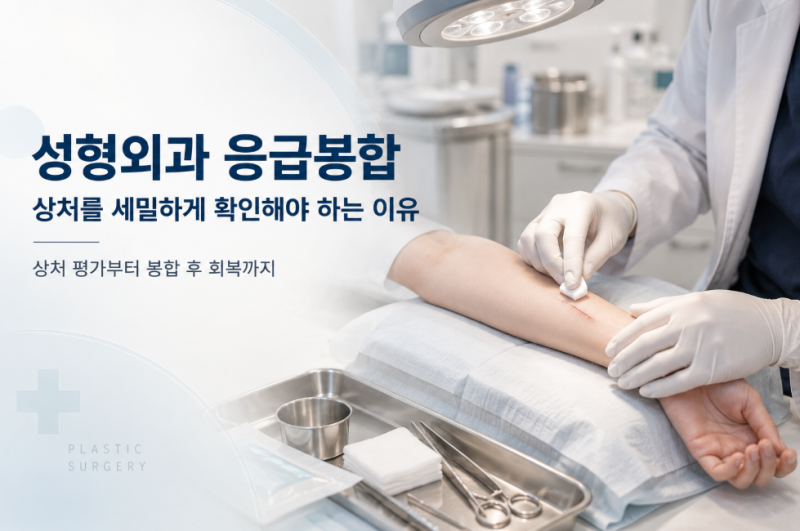
A 1 cm Wound: Suturing Is Never Decided by Length Alone
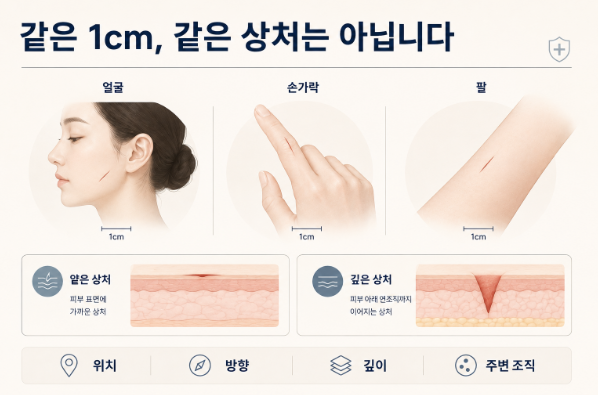
Even if two lacerations appear to be identical 1 cm cuts on the surface, their actual internal conditions may differ completely.
While some wounds are relatively superficial lacerations confined to the skin surface, others may involve deep tissue damage despite appearing small from the outside.
Furthermore, a 1 cm wound on the face, a 1 cm cut on a finger, and a 1 cm laceration on an arm or leg require entirely different evaluation points.
This is why plastic surgeons never decide how many stitches to place based solely on the wound's length.
Where the wound is located
In which direction the tear occurred
How deep the damage extends
What the condition of the surrounding tissue is
Whether contamination or foreign substances are present
Whether additional examinations or treatments are required
All of these factors are verified first.
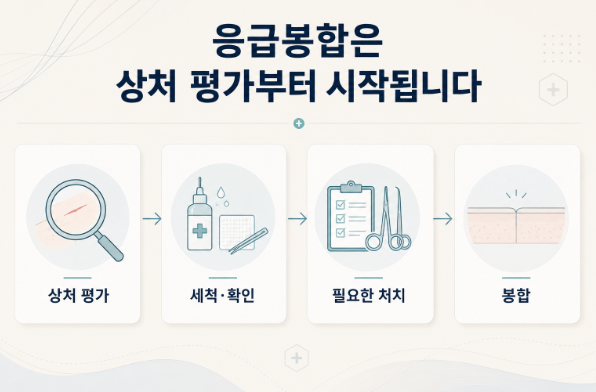
When necessary, the wound is irrigated and checked for contamination or foreign debris, and if deeper tissue damage is suspected beneath what meets the eye, the surgeon determines whether further diagnostic evaluations or interventions are warranted.
Wound Assessment
→ Irrigation & Contamination/Debris Check
→ Additional Diagnostic Tests (if needed)
→ Treatment Plan Based on Damage Extent
→ Suturing
In other words, emergency suturing does not begin with "stitching up the wound"—it begins with "accurately identifying the true extent of the wound."
How Does a Board-Certified Plastic Surgeon View a Wound?
One primary reason patients consider plastic surgery for emergency suturing lies in the specialist’s perspective on wound anatomy.
A board-certified plastic surgeon evaluates the current state of damage by taking into comprehensive account the skin, soft tissues, and surrounding structural dynamics.
For instance, on the face, the periorbital area, nose, and lips each possess distinct anatomical structures and dynamic movements.
For the hands and fingers as well, it is not merely about looking at the skin; one must meticulously examine the exact location and depth of the laceration, the status of surrounding tissues, and the functional mobility of the area.
The same applies to injuries on the arms or legs.
Even if the external wound appears small, the required treatment can vary significantly depending on whether damage extends to deeper layers and how surrounding structures are affected.
Therefore, what a plastic surgeon checks is never simply:
“How many stitches will this need?”
Instead, they systematically assess:
“Which anatomical structures have been compromised?”
“To what depth does the injury penetrate?”
“What is the functional and anatomical condition of the surrounding tissues?”
“What is the most appropriate surgical and therapeutic technique?”
“What specific factors must be tracked during subsequent tissue recovery?”
Even for lacerations of the exact same size, the necessary interventions and suturing techniques will differ based on these clinical evaluations.
Proper Initial Assessment Is Just as Vital as Precise Suturing
When an injury occurs, it is easy to focus only on the act of suturing itself.
However, in the clinical process, how the wound is evaluated before closure and how necessary interventions are determined are just as critical.
This is because appropriate, tailored care can only be delivered after checking whether there is internal contamination or foreign bodies, whether damage runs deeper than the visible tear, and what state the adjacent tissues are in.
In plastic surgery, these meticulous steps guide every decision before proceeding with sutures.
Regional characteristics are also factored in carefully.
For highly visible areas like the face, future recovery and scar minimization are prioritized from the outset. For high-mobility areas like the hands or fingers, the position of the laceration and the state of nearby functional structures are examined in meticulous detail.
Thus, even under the shared term "suturing," the clinical reasoning and underlying care procedures involved are far from identical.
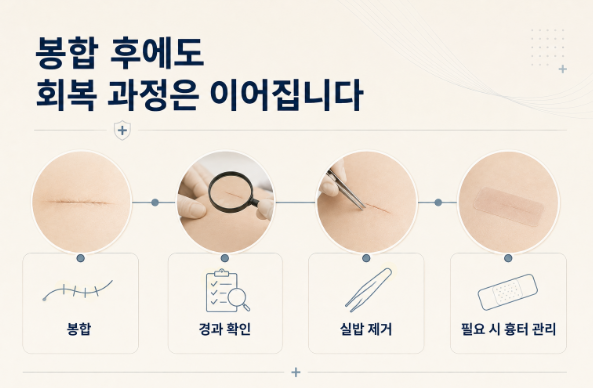
Care Does Not End With Just Removing the Stitches
Another key aspect plastic surgery emergency suturing emphasizes is the continuum of care after the procedure.
A wound that appeared neatly closed right after suturing can undergo various changes during tissue healing, making close follow-up and monitoring essential.
At Girin Plastic Surgery Trauma Clinic, depending on the condition of the wound, our structured protocol covers:
Initial Wound Assessment
→ Necessary Treatment & Precision Suturing
→ Recovery & Healing Monitoring
→ Suture Removal at the Optimal Time
→ Scar Management (if necessary)
All seamlessly connected into one unified care pathway.
Notably, scar outcomes are not determined solely at the moment the needle passes through the skin.
They are influenced by multiple variables, including the initial location, depth, and extent of the injury, as well as every stage of the subsequent healing process.
Of course, having a plastic surgeon perform the suturing does not mean a scar will be 100% invisible.
The critical difference is not an unrealistic claim of "stitching without any trace," but rather treating the wound from the very first evaluation with the long-term recovery and aesthetic outcome in mind.
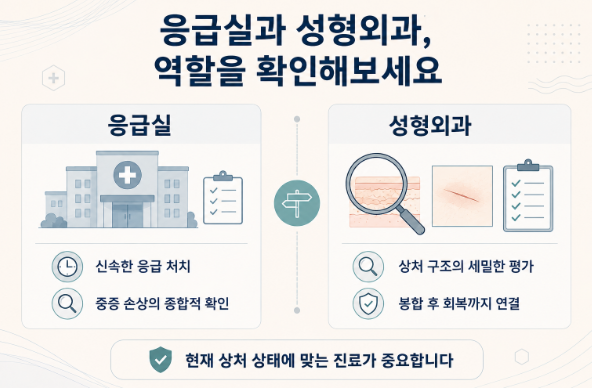
So, What Is the Difference Between the Emergency Room and Plastic Surgery?
Emergency rooms play a vital role in promptly administering life-saving interventions during sudden accidents and acute emergencies.
In particular, if there is massive bleeding, multiple trauma from a severe accident, or suspicion of critical injuries like fractures or neurovascular damage, comprehensive emergency medical intervention must always take precedence.
Plastic surgery shares the same foundational purpose of treating wounds.
However, plastic surgery emergency suturing allows for a detailed evaluation of the wound’s exact location, depth, trajectory, and surrounding tissue status, executing precision suturing while linking directly into long-term scar and recovery management.
Therefore, rather than simply debating which option is superior, it is recommended to choose based on your current clinical situation:
Determine whether immediate, life-stabilizing systemic treatment is the urgent priority,
or whether detailed anatomical evaluation of the wound and continuous post-suture recovery management is what you need.
24/7, 365 Days: From the Moment of Injury to Complete Recovery
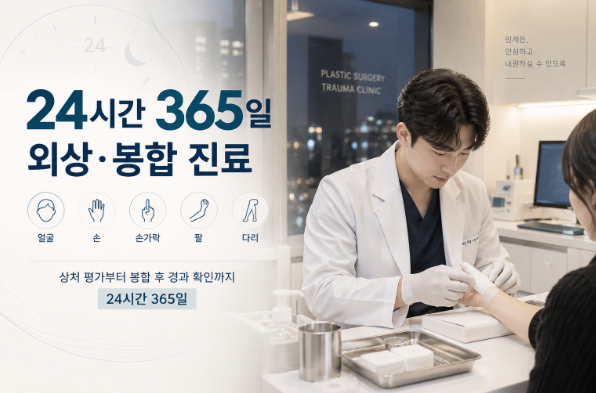
Trauma does not wait for convenient hours.
Unexpected lacerations to the face, hands, fingers, arms, or legs can happen late at night, in the early morning hours, on weekends, or during public holidays.
Girin Plastic Surgery Trauma Clinic operates 24 hours a day, 365 days a year for trauma and emergency suturing care.
Operating 24/7 does not merely mean that "stitches can be done at any time."
It means that when an injury occurs, a board-certified plastic surgeon personally assesses the condition, determines the necessary treatment and closure method, and monitors the healing journey all the way through.
Even with a small wound, what needs to be verified is rarely small.
Rather than deciding how many stitches are needed based merely on wound length, we look closely at where and how the damage occurred first.
This is the standard by which Girin Plastic Surgery Trauma Clinic approaches emergency suturing.
Frequently Asked Questions
What is the difference between emergency suturing at a plastic surgery clinic and at an emergency room?
The main difference lies in the clinical perspective of wound assessment and the post-procedure healing management. While emergency rooms prioritize rapid stabilization for severe conditions such as massive bleeding or multiple trauma, plastic surgery focuses on precisely identifying the depth, trajectory, and surrounding tissue status of the laceration, providing precision closure coupled with long-term recovery and scar management.
Does getting emergency sutures from a plastic surgeon guarantee zero scarring?
No. Receiving sutures from a plastic surgeon does not mean an injury will heal without any trace whatsoever. Scar formation is influenced by diverse factors including wound location, depth, severity of trauma, and individual healing processes. However, plastic surgeons minimize scar formation by meticulously planning closure and recovery from the initial assessment onward.
Is a plastic surgery visit necessary even for a small 1 cm cut?
Yes. Even if a laceration appears small on the surface, deeper soft tissue or structural damage may be present beneath the skin. Rather than determining care by surface length alone, it is essential to evaluate depth, structural involvement, and foreign contamination to administer treatment tailored to the specific anatomical area.
Is plastic surgery emergency suturing available at night or on holidays?
Yes, medical care is available 24/7, 365 days a year. At Girin Plastic Surgery Trauma Clinic, board-certified plastic surgeons personally inspect the wound, administer tailored procedures and closure, and connect patients to systematic recovery care even late at night, in the early morning, on weekends, and during public holidays.