2026-09-09
Why Wound Suture Surgery Should Be Done by a Plastic Surgeon
Discover why wound suture surgery should be performed by a plastic surgeon. Learn about minimizing scars, tissue alignment, and 24/7 trauma care at Girin Plastic Surgery Clinic in Gangnam, Seoul, South Korea with board-certified plastic surgeons and 1:1 tailored consultations. Emergency trauma care available 24/7/365 with professional translators on site for global patients visiting Korea for medical tourism. Discover more about safe surgical procedures and comprehensive post-op care programs. C
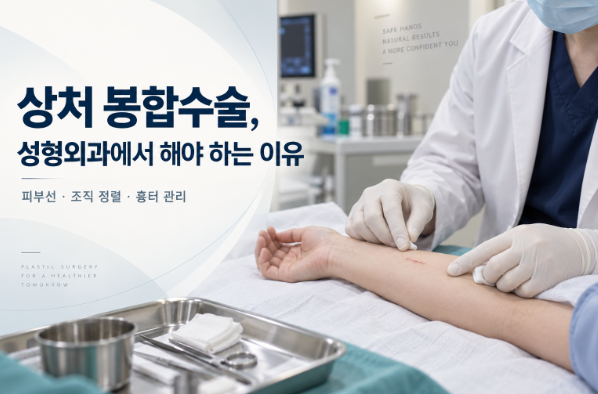
Why Wound Suture Surgery Should Be Done by a Plastic Surgeon
Hello.
This is Girin Plastic Surgery.
When you suddenly fall
or suffer a laceration from a sharp object,
wound suture surgery is the necessary treatment.
If the wound is gaping,
suturing to close the skin may be required.
However, for areas like the face, hands, or fingers
that are highly visible or involve frequent movement,
it is difficult to simply think about "closing the wound."
This is because you must also consider
how the remaining line on the skin will look after healing,
whether tension will occur during movement,
whether surrounding tissues can be aligned naturally,
and how subsequent scar management should proceed.
Therefore, wound suture surgery
is not a mere quick fix,
but a treatment that requires consideration from the very first stitch to the final stages of recovery.
Today,
we will explore why wound suture surgery should be performed by a plastic surgeon
and what plastic surgeons focus on during suturing.
Plastic surgery suturing considers directions that minimize visible scarring
When a wound occurs,
it cannot be said that no scar will remain at all.
After skin is lacerated,
some degree of mark may be left behind during the healing process.
However, depending on how the wound edges are aligned during the initial suture,
how the site is adjusted so it is not pulled too tightly,
and how naturally the tissues are realigned,
the visible difference during recovery can be significant.
Plastic surgery suture procedures
do not merely focus on closing the skin.
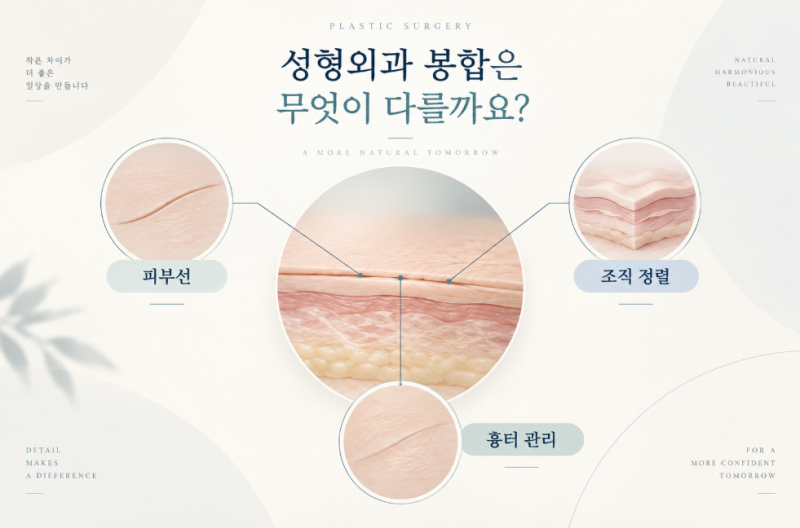
We consider skin tension lines, tissue alignment, dynamic tension, and the entire recovery process
to ensure scars are as inconspicuous as possible.
In other words, the reason to choose a plastic surgeon for wound suturing
is that the closure is performed from the start with a focus on making the scar less prominent.
Evaluating skin lines and tissue alignment together
What matters in suture surgery
is not just the number of stitches.
It is crucial to verify whether
the skin height matches on both sides of the wound,
the skin margins are precisely aligned without shifting,
and underlying deep tissues are not left gaping.
Just because the surface of the skin is closed
does not always mean it will lead to optimal healing.
If the tissues beneath the wound are mismatched
or excessive tension is placed on the skin,
a pulling sensation may be felt during recovery,
or the scar line may become much more noticeable.
In plastic surgery closure,
a wound is not viewed as a simple line;
rather, we thoroughly assess how the skin and soft tissues should be brought together.
This meticulous approach forms the core expertise of plastic surgery suturing.
Facial wounds require even greater care
The face is an area
that demands exceptional caution in wound suture surgery.
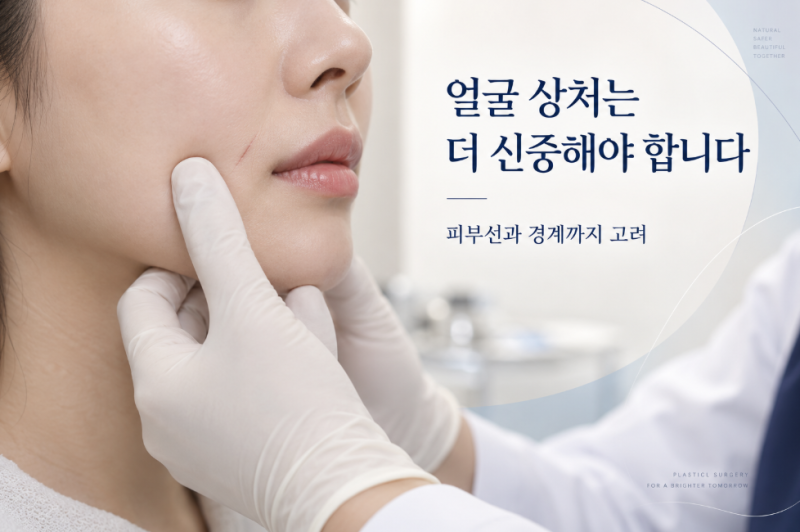
Facial wounds
can easily stand out even after healing,
and areas around the eyes, nose, and lips
feature distinct skin thicknesses and complex anatomical structures.
In particular, the border between the skin and vermilion around the lips is critical,
and the periocular skin is very thin and subject to continuous expressive movement.
For such regions,
rather than merely closing the laceration,
it is vital to align the tissues so they connect naturally with surrounding structures.
Therefore, it is recommended
to have facial wound suturing evaluated by a plastic surgeon.
This allows skin lines, anatomical borders, tissue alignment, and post-recovery scar care
to be comprehensively managed together.
Wounds on the hands and fingers must account for movement
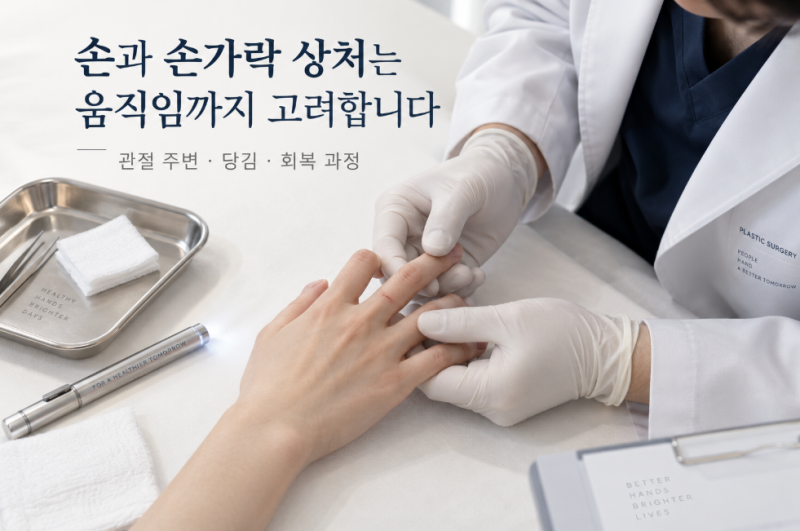
Hands and fingers
are moved countless times throughout the day.
Bending and extending fingers,
grasping objects,
and moving the wrist
repeatedly transmit mechanical forces across the sutured site.
For this reason, hand or finger wounds
cannot be judged solely by their visible size.
One must check whether the wound is near a joint,
whether tension will occur during motion,
and how the skin and surrounding structures should be aligned.
In plastic surgery wound closure,
the suturing strategy is designed to accommodate these movements and tensile forces
based on the specific wound condition.
Even for a small finger wound,
if it is located in a high-mobility area,
the initial suture technique becomes even more critical.
Key considerations in plastic surgery wound suturing
When receiving wound suture surgery,
it is more important to know the criteria used for closure
than simply asking "can it be stitched up?"
Plastic surgery suturing primarily evaluates the following factors:
Category | Key Focus |
Skin Lines | Aligns with natural relaxed skin tension lines so the resulting mark is less visible after healing. |
Tissue Alignment | Ensures the skin and surrounding soft tissues match naturally layer by layer. |
Tension | Checks that excessive force is not placed on the suture line due to movement or skin tension. |
Anatomical Structures | Applies differentiated approaches for sensitive anatomical landmarks such as the face, lips, eyes, and fingers. |
Scar Management | Monitors healing after suture removal and provides scar care protocols when necessary. |
These considerations
do not make wound care unnecessarily complicated.
They are steps planned from the very beginning
to ensure that after the wound heals,
scars are less visible
and skin and underlying tissues recover in the most natural manner possible.
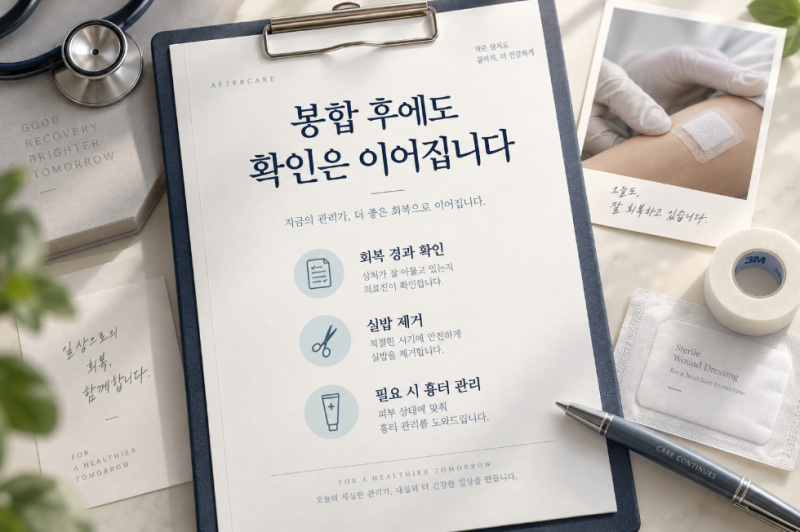
Seamless continuation to post-suture scar management
It is easy to assume
that suture surgery ends entirely once the stitches are removed.
However, a wound
is not fully healed the moment sutures come out.
Over time, the sutured area goes through a healing trajectory
where redness gradually subsides,
passes through a phase of tissue induration (firmness),
and slowly blends into the surrounding skin.
Throughout this period,
it is important to assess whether the wound is healing soundly,
whether the timing of suture removal is optimal,
and whether specialized scar treatments should be initiated.
At the Girin Plastic Surgery Trauma Clinic,
we provide integrated, continuous care tailored to each wound condition:
Wound Assessment
→ Suture Surgery
→ Recovery Progress Monitoring
→ Suture Removal
→ Post-Suture Scar Management (as needed).
The reason to seek a plastic surgeon for suture surgery
is not just for the initial stitches,
but to ensure continuous follow-up through recovery and dedicated scar care.
Consider plastic surgery suturing for these types of wounds
Not every wound is treated in the exact same manner.
Depending on the location, depth, extent of bleeding, and contamination level,
the required clinical approach may vary.
However, a plastic surgery evaluation is strongly advised in the following situations:
Wounds on prominently visible areas such as the face
Wounds involving delicate anatomical landmarks like the eyes, nose, or lips
Wounds on high-mobility regions like the hands or fingers
Arm or leg lacerations where visible scarring is a concern
Cases where you wish to receive integrated care from suturing to stitch removal and scar management
For these lacerations,
treatment should not stop at merely closing the skin;
it is far better to consider the post-healing contour lines and recovery trajectory from the outset.
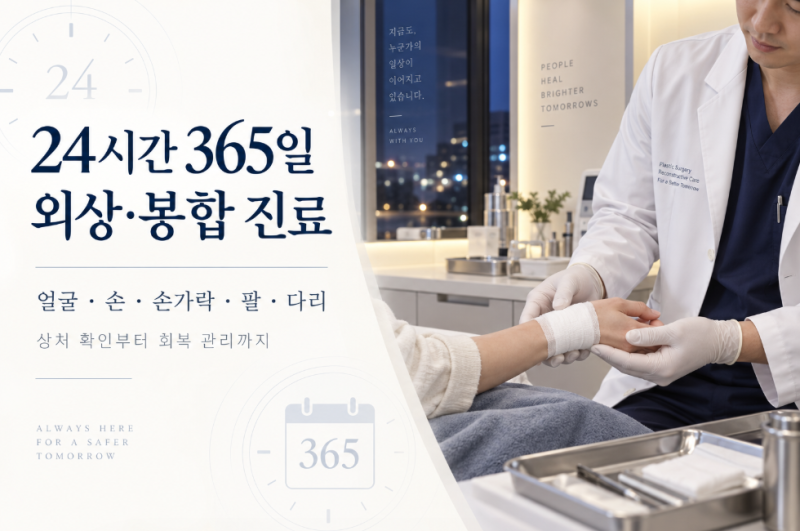
24/7 Trauma and Suture Care, 365 Days a Year
Accidents do not keep regular hours.
Late at night, in the early morning hours,
or during weekends and public holidays,
unexpected lacerations can occur
on the face, hands, fingers, arms, or legs.
The Girin Plastic Surgery Trauma Clinic
operates 24 hours a day, 365 days a year for trauma and wound suturing.
This means more than just having stitches available late at night.
It means delivering continuous medical care matched to each recovery phase—
from the moment the injury occurs
through surgical suturing, suture removal, and individualized scar care as required.
Wound suture surgery
does not end with simply closing the skin.
It is essential to evaluate together
how the skin lines will appear once healed,
whether movement will create pulling or tightness,
and how subsequent scar care should be carried out.
This comprehensive view is precisely why
Girin Plastic Surgery emphasizes the necessity of having wounds closed by a plastic surgeon.
Conclusion
On the surface,
wound suture surgery may look like a simple stitching procedure.
However, for areas that are highly noticeable or frequently moving, such as the face, hands, or fingers,
the initial suture direction and post-care management are vital.
Plastic surgery suturing goes beyond closing a wound;
it is an integrated treatment considering skin lines, tissue alignment, structural tension, and scar prevention.
While no procedure can guarantee the total absence of scars,
planning from the very beginning to make the scar as unnoticeable as possible
and following through with dedicated post-suture care
is the ultimate reason
to choose a plastic surgeon for wound suture surgery.
Frequently Asked Questions
Why should wound suture surgery be performed by a plastic surgeon?
Plastic surgeons comprehensively evaluate skin lines, tissue alignment, and tension to ensure scars remain as inconspicuous as possible. Rather than just closing the wound surface, they precisely align underlying soft tissues and continue care through suture removal and scar management.
What requires special attention when suturing facial wounds?
It is essential to precisely match variations in skin thickness and structural borders around delicate features like the eyes, nose, and lips. The vermilion border of the lips and the expressive, thin skin around the eyes demand meticulous tissue alignment and post-healing scar follow-up since irregularities can be easily noticed.
Is plastic surgery suturing necessary for lacerations on the hand or finger?
Yes. Hands and fingers undergo constant movement and tensile stress, making plastic surgery suturing highly beneficial. Because joint movements place repeated tension on the wound, surgeons plan closure based on joint location and dynamic tension rather than just wound size.
Is treatment finished once the stitches are removed after wound suturing?
No, skin recovery and scar monitoring must continue even after suture removal. The sutured area goes through phases where erythema fades and tissue firmness softens, requiring timely stitch removal and appropriate subsequent scar care suited to the wound's healing stage.
Can I receive trauma and suture care at night or on weekends?
Yes, 24/7 trauma and suture care is available 365 days a year, allowing prompt treatment during night hours and weekends. Patients can receive prompt primary closure immediately after injury, followed by step-by-step follow-up care from stitch removal to customized scar therapy.